
Double Uni Knot or Uni to Uni Knot
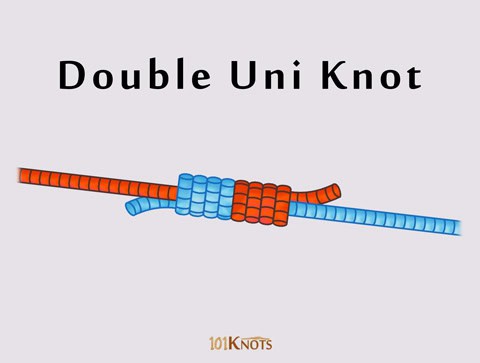
Double Uni Knot / Uni to Uni Knot
You can join 2 lines of varying or similar strengths with this fishing knot. It is basically tying the uni knotwith the line doubled, twice at 2 ends. It is used by both salt and freshwater anglers. When tying braid to mono, make 5+ turns with the mono and 8 turns with the slippery braid. It can unite a fluorocarbon leader with a braided main line and is a good mono to mono knot. It is also known as the double Grinner knot.

Tips
- If you are not using the swivel, the double uni knot is a good option.
- Breaking strength is less than 100% but over 90%.
- It can be used for tying tapered leaders or tippets
Variation
- Double double uni knot – For joining a braid to a fluoro leader, the former is doubled over before tying the knot.
|
Advantages |
Disadvantages |
|
• Works well • Strong when tied correctly • Quick to tie • Simple • Doesn’t slip or break in most cases |
• Not the strongest option for braid to mono and braid to fluoro leader connections. • When tying mono to braid, tends to overstretch the mono. |
Double Uni v/s Other Knots
- Easier than the blood knot.
- The FG and J knots are stronger.
- Passes more easily through guides than the Albright knot.
- The Alberto knot, though smaller, keeps rubbing against rod guides and becomes loose letting go of precious catch. The double uni is better in this respect.
- It is stronger than the surgeon’s knot. However, the latter can be tied faster.
- More reliable than the Seaguar knot.
- Though it works for braid to braid unions, the modified double uni boasts of a greater breaking strength.
Uses
- Fly fishing.
- To connect super lines or braids to mono or fluoro leaders.
- To join shock leader to mono.
- On drop shot rigs.
- For lure casting.
How to Tie a Double Uni Knot Step by Step
- Overlap the 2 ends 2 and wrap the blue end around both ropes
- Take it out through the loop and pull as directed
- Take the red end and wrap it around both ropes
- Pass it through the loop formed by the red rope
- Pull to tighten
- Pull the standing parts in opposite directions
- The individual knots will draw close together. Trim off excess tag end
- The knot is made
