
Spider Hitch
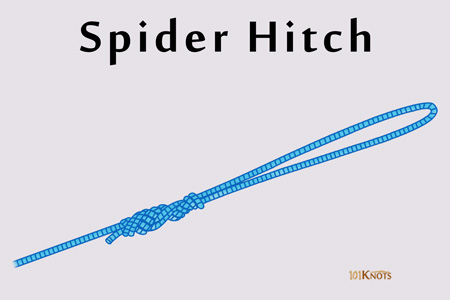
Spider Hitch
The spider hitch quickly forms a double line or a loop in the line for light tackle fishing. It is easier and faster to tie than the Bimini twist but lacks the latter’s shock absorption capacity. It is also not as durable and effective on small diameter lines like braided lines as the latter. For mono lines, both have almost the same breaking strengths. The Bristol or no name knot is sometimes used to join a heavier leader to the double line of the spider hitch.

Tips
- When tying on a braided line, wrap 15 times in step 2.
- In step 6, moisten with saliva before pulling for a tight knot.
|
Advantages |
Disadvantages |
|
• Retains most of the line’s strength • More consistent and faster than the dropper loop • Creates a strong, large loop in leader and/or tippet • With proper practice, can be tied in under 10 sec • Can be tied even in rough weather conditions |
• If the wraps do not come out in the proper order while tightening, the knot may fail |
Uses
- Fishing.
- On shark/ tarpon rigs.
- Joins a mono leader to braid.
- For shore fishing over irregular ground, connects a rubbing leader/ shockleader to a mono mainline.
- Provides an option to join the doubled mainline directly to the link or swivel if you are fishing leader-less.
Steps to Tying a Spider Hitch
- Make a double line loop holding it between thumb & finger
- Pass the end over the thumb
- Wrap the end 5 times around the thumb
- Pass the end behind the loop
- Now pass it through the loop
- Pull the end out of the loop
- Pull both ends to tighten the knot
- Trim excess tag end
